
Our Products

Coating Line

ربات پاشش پودری الکترواستاتیک

Reciprocator

Powder Spray 

Powder Recovery

Powder Coating


فروش رنگ پودری

Powder Coating

Due to its unique characteristics, electrostatic powder paint has long been appreciated by craftsmen. Powder paint, or electrostatic paint, is a better option than other traditional competitors that require solvent for use. With powder paint , you can achieve a uniform and  high quality coated surface in solvent-free condition. If you want to inquire about the price of electrostatic paint or buy electrostatic powder paint, you can call us.

As powder paint is cured in a heating process, it is much more resistant and long-lasting than solvent-based paints. In addition, external factors such as the skill of the painter and environmental factors will not have much effect on the final quality of the work. Now, we will take a look at what it is and technical explanations about electrostatic powder paint.

Applications

Powder coating is a well-known and common process, because powder paints:

They are environmentally friendly.
They help a lot to save energy.
They have high safety during use.
They are very affordable compared to other traditional competitors.

As mentioned, the basic idea behind electrostatic powder coating is based on the fact that parts with opposite electrical charges attract each other.

Therefore, most conductive and thermally stable solids are suitable for powder coating. Most importantly, nowadays, metal objects are electrostatically coated with powder paint. Usually you have seen its use in these cases:

Home Appliances, office furniture, Garden equipment, Car accessories, connections, Wire goods and Metalworks

Powder Recovery System

The function of a powder recovery system is to collect the over sprayed material and render it suitable for recycling and at the same time to remove the powder particles from the exhaust air stream before discharging into the atmosphere.

بازیافت رنگ پودری

We provide three types of powder recovery system, offering the best solution to eliminate profit loss due to expensive wastage and costly downtime for powder change.

In continuous coating lines, it is mostly common to install  mono cyclone and after filter  together. In this way, the efficiency of the equipment is approximately 99.9%. Elcoat recovery systems are produced at high quality and designed  for each single project.

Mono cyclone + after filters recovery system

It is ideal for single as well as multi color operations. Cyclone separator is used to separate the over sprayed powder in the air-flow. The working principle is based on centrifugal effect.

Multi cyclone + after filters recovery system

It is an improved technology based on mono-cyclone. The small height of cyclones allow for easy mobility and faster cleaning operation.

Twin filter cartridge recovery system

Our filter cartridge system is an improved technology, ideal for multi color powder . Normally we equip the filter cartridge at each side of the auto booth, the knock-down design enables really quick color change and easy clean.

Powder sieving system

During powder spraying process, some powder is not ionized and does not settle down on the intended parts. To recover the powder, it is collected at recovery section with the aid of cyclone or filters. To reuse the powder and mix the new powder with the used one, it is necessary to apply the sieving machine in the process. To reduce cost and optimize the system, the sieving machine can play an effective role in the coating system. The features are as follow:

  •  Possible control on vibration rate
  •  No waste in time or labor force
  •  Powder loss prevention
  •  Permanent installation on automatic systems

Powder Center

The advantages of powder center:

– Designed for quick color changes

– Using the powder directly from the original container

– An independent exhausting air system prevents powder loss

– An even powder output due to level-controlled injectors

– Automatic internal cleaning of the injectors, hoses and guns

– Optimum powder quality due to built-in sieving machine

Powder Hopper

Perfect fluidization for ideal powder preparation
A high quality fluidized bed evenly distributes the compressed air over all the hopper surface allowing ideal powder delivery.

  • Easy integration in every system
    Fresh powder, recovery powder and air mover connections offer easy integration possibilities into any system.

Powder Spray System

The 5th series of ELCOAT powder coating system, Sigma Plus and Sigma 2 have new outstanding options, in addition to their nice looking and more stable structures. The structure makes it possible to install two units on a system body and they work at the same time using just a single barrel. The most significant changes in electronic part are to powder coat parts in the corner by easy current controlling and re-coating painted parts. Elcoat system can be easily converted to the one using vibrator instead of powder barrel. This system uses a powerful vibrator which helps the operators to minimize color change interval time when frequent color change is inevitable.

 Sigma Plus Spray Gun System 

Installation & Operation 

ربات پاشش پودری

Sigma Plus Reciprocator 

The objective of using reciprocator is to achieve uniform spraying of powder or paint on moving objects by precise & smooth up & down movement of Guns (stroke) at various speeds. The spraying guns are mounted on an arm extended from a carriage. It is programmed to move in required stroke lengths & speeds depending on object height for up & down movements of guns.

Elcoat reciprocator is controlled by a full programmed PLC with which, several programs for spraying different parts can be saved and selected and used easily by the operator. Also, the PLC gives the chance to adapt the conveyor speed and powder spray rate.

ربات پاشش پودری

Sigma Plus Central Control Unit (CCU)

It is the heart of an automatic powder coating line. It directly controls the powder coating whole process, the movement of reciprocators’ arms and the rate of powder coating, so that the operator can monitor the whole coating zone operations, easily and closely. In ELCOAT system, up to 8-10 powder spray guns can be monitored and necessary changes can be made in line within a minute.

Considering the ease of operation with Elcoat control, you have a grip on all coating parameters. Clear symbols, simple programming and a perfect reproducibility of your results contribute to measurably increase your coating quality. Elcoat central control is suitable for all kinds of applications. Its compact design is very easy to adapt into any plant lay-out.

Coating Lines

Sublimation  

After initial powder coating, the metal pieces are covered by special papers used in subli décor process. These types of papers consist of particular inks that penetrate beneath the metal surface during this physical process. 

When the sheet or profile is completely covered by paper, through a vacuum suction system all inside air is taken away. This procedure permits the complete attachment of the paper on the piece and the perfect result of the thermo-print.

 Physical phenomena in the substance changes directly from a solid condition into a gas condition. The piece stays at temperatures about 200-220 ° C few minutes. After cooling and the solidification of the paints, the paper will be removed. Heat, pressure and time are together responsible for the result of the process.

As different aluminum profiles require different width of heat transfer film/paper, it is necessary to cut the film/paper in roll by slitting machine. To Cut the film or paper roll into pieces , the roll is loaded in the machine, completely fixed in its place, to avoid any movement during blade high speed rotation. The width of the section is precisely measured and the blade is locked. By starting the machine, the roll section is cut in a few seconds.

The ultrasonic welding technology is used in film bagging machine, which the heat fuses transfer film together. Exposed to ultrasonic generating box, the film starts to vibrate. Two sides of the film starts to create friction and the heat of friction reaches the melting point of the film, therefore, the film layers are being welded together.

To run the machine, electrical power and compressed air is required. As shown in the picture, the film is loaded into a air expansion shaft. Then the film is folded in U shape and connected together into the welding zone. 

By turning on the ultrasonic , and pressing the sonotrode onto the film, the welding is done. The profiles are placed on the table and loaded from one side, and are covered with film, passed the welding zone and unloaded from the other table by operators. The film wrapped profiles , then, are charged one by one in sucking heads in heat transfer machine, where air between the film and profile surface is completely removed. Then they are placed in the oven to complete decoration process.

Applications

Door Industry: security doors, garage doors, interior doors, door frames, window frames, etc.

Building and construction: internal & external walls, roofs, partitions, ceiling,  kiosks, garage, and ventilation ducts

Furniture: refrigerator, wardrobe, washing machines, air conditioners, electric fans, lamps, solar water heaters, electric water heaters, etc.

Traffic: decorative board, train partition and interior decoration panels, ship partition and interior decoration board

Household appliances: refrigerators, freezers, washing machines, air conditioners,  etc.

Office: copier cabinet, vending machines, computer cases, switch gear, cabinets, tool cabinets, Elevator interiors

Powder Coating Process

Powder coating is an increasingly popular method for providing a protective and/or decorative coating on metallic objects. Unlike liquid paints, a powder coat is a dry material that will not drip or run upon application. Powder coating is most commonly used on metals such as iron or steel.

The powder-coat process entails the application of electrostatically charged particles onto the surface of the substrate. In a typical powder-coating system, a feeder unit delivers the powder to an electrostatic gun. The feeder unit also controls the flow of powder to the gun. The gun emits the powder in the form of a diffused cloud. When combined with an electrical field charge provided by a low-amperage power unit, the charged particles seek out and adhere to the surface of the substrate.

Upon application of the coating, the next step in the powder-coating process is curing, which involves baking the workpiece in a specially designed oven. Curing results in the formation of a protective skin and promotes coating adhesion. In general, curing is performed at 400 F for approximately 20-30 minutes, although these parameters can vary based on the type of powder coating.

Surface pretreatment is also essential for achieving a successful powder-coating outcome. This normally entails the removal of grease, oil, dirt and other materials via chemical, physical or mechanical methods to clean the surface and promote coating adhesion. Pretreating the workpiece with chemical compounds can enhance the coating’s performance, durability and corrosion resistance.
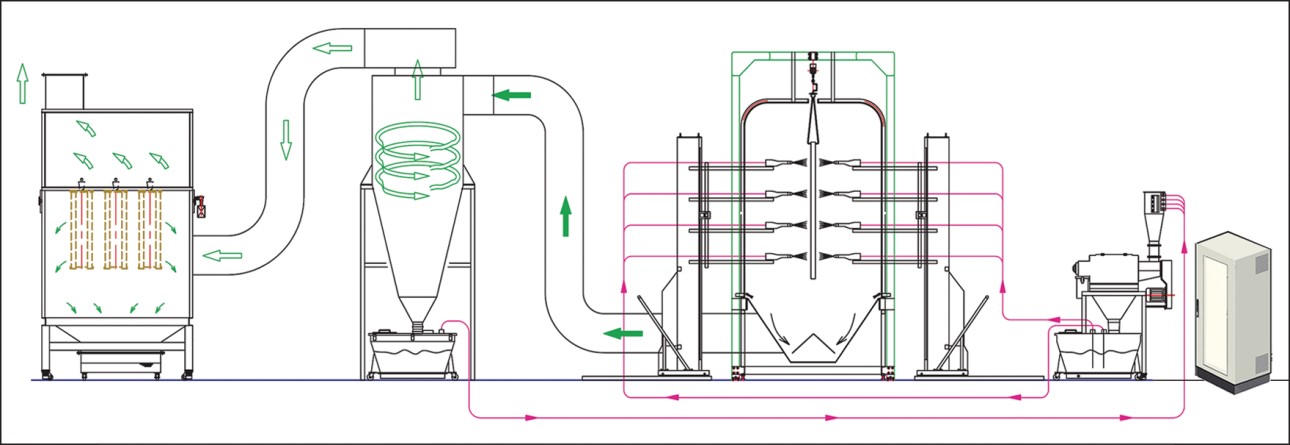
As shown in above schematic coating zone, there are 6 main equipment which are applied in automatic powder coating line. When the powder is negatively charged, it leaves the guns mounted on reciprocator’s arms and disperses in powder booth. The powder settles on part surface and the over sprayed powder is removed from booth area with help of a mono cyclone. The powder is recovered in a 2-stage recovery system including mono cyclone and after filter system.

The recovered powder is sent to the sieving machine and then charged to powder hopper. The fresh powder is mixed with the recovered one, and pumped to spray guns. The whole process is controlled in central control unit. The conveyor system and curing oven complete the powder coating plant. Based on the production capacity, the parameters for the best results are calculated and manufactured accordingly.


Pretreatment

During the preparation, the metal has to go through a cleaning process. This is to remove any foreign substances that will hinder the success of the coating process. A chemical is used to remove oil, lubricant or grease on the metal. Another method is blasting, which utilises a blasting medium to remove metal edges and serve as a finishing touch. Instead of subjecting the metal object to a grinding machine to remove edges or to polish, blasting is a more efficient and faster method.

Powder booth

The purpose of the powder booth in electrostatic spraying is to ensure that powder from the application device stays inside the booth. This then offers the opportunity to collect the over sprayed powder ,recover it and re-use. Elcoat powder booth, is designed and manufactured at high quality and a variety of sizes and configurations are available to suit any type of powder coating operation. Conveyor openings and length extensions are also available. Elcoat offers powder coating booths that provides high-performance and provides energy-efficient powder coating environments.

Powder Coating Spray

The electrostatic spray method is the most commonly used technique for applying powder coatings. This process involves charging powder particles electrically and spraying them onto a grounded part. The electric charge ensures that the powder adheres to the surface until it’s melted and fused into a smooth coating in the curing oven. This method is highly efficient, allowing for quick application and minimal waste since excess powder can be collected and reused.

Elcoat utilizes this method for a variety of applications, offering excellent coverage, uniform thickness, and a vast selection of colors and finishes. Suitable for metal substrates like steel and aluminum, it’s a versatile choice for everything from automotive parts to household appliances.

Powder Curing 

The final part of powder coating process is known as curing. The surface of the metal, or the substrate, is already coated, and the coating is in a powdered form, which means it is ready for the finishing touches. Curing is designed to make a powder adhere to the metal so firmly that it will last for years. It also turns the powder into a smooth substance that looks like it has been painted on. 

The curing process entails applying heat to the coating at a specific temperature so that it will achieve the final objective of the powder coating method. The coating should not be subject to direct heating, meaning that heating elements should not touch the powder coating, as that would simply burn it.

The items being processed need to be placed inside an oven, which contains heating coils. The heating coil will direct infrared heat to the whole coated object, a process known as convection heating. Convection heating lets the heat travel to the substance without direct contact so that the heating coils do not touch the coated object. In simple terms, it is just like a person inside a sauna room!

The oven is set to the required temperature, and there should be a timer to control the time of curing. With the correct amount of time and temperature, the powder coating will form a solid film of plastic wrap around the metal.